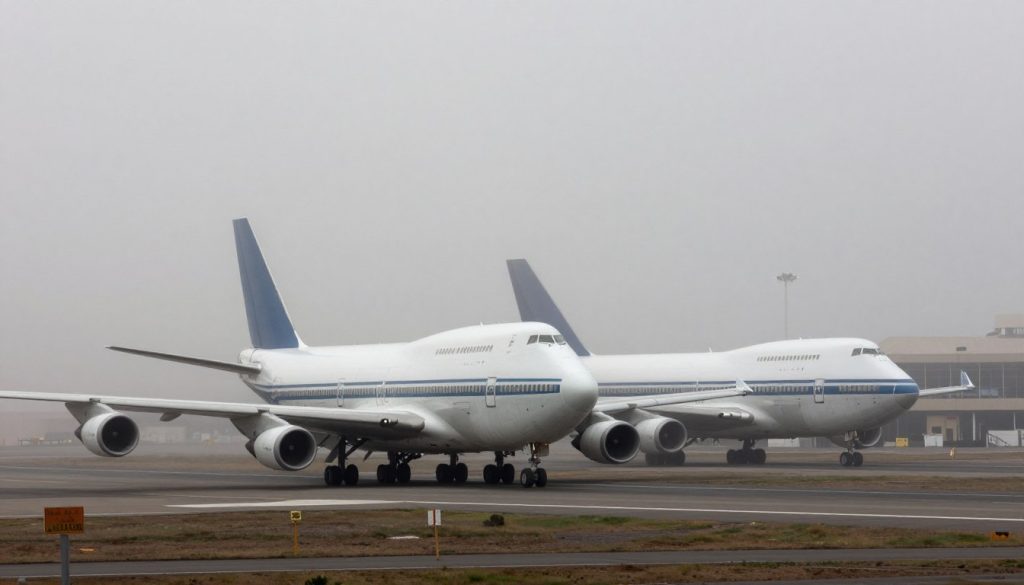
The 1977 Tenerife runway collision, in which two Boeing 747s hit each other in fog on March 27, 1977, killed 583 people and remains the deadliest accident in aviation history. Two fully loaded jets met on a fog-covered runway on a Sunday afternoon at a small regional airport in the Canary Islands.
Most of the people aboard had never planned to be on Tenerife at all. The island was a detour on the way to a holiday. A bomb, a closed airport, a crowded ramp, drifting fog and a few unclear radio calls lined up within a single afternoon, and each one looked harmless on its own. The story below follows that chain from the first diversion to the rules it changed. Almost nothing about that afternoon was planned, and that is exactly why it still matters.
Key Takeaways
- The collision on March 27, 1977 killed 583 people, the highest toll of any aviation accident.
- A bomb at Gran Canaria Airport sent both jets to the much smaller Los Rodeos Airport.
- Dense fog and a blocked taxiway forced both planes to share one runway.
- The KLM captain began his takeoff roll without takeoff clearance.
- Overlapping radio calls hid the Pan Am crew’s warning from the KLM cockpit.
- Standard phrases and crew resource management emerged from the disaster.
Why the Tenerife Disaster Is the Deadliest Accident in Aviation History
Tenerife holds the record: no other aviation accident has killed more people than the 583 who died on March 27, 1977. The Tenerife 1977 plane crash is also the deadliest accident ever recorded at an airport. Neither flight was in trouble before the collision, and neither aircraft had a mechanical fault.
The record did not come from a dramatic failure in the air. The 583 deaths are the highest toll in the history of aviation, set on a runway in clear working order. Three points frame the scale:
- Tenerife, 1977: 583 deaths, the most of any aviation accident.
- Japan Air Lines Flight 123, 1985: 520 deaths, the deadliest accidental crash of a single aircraft.
- Neither Tenerife 747 suffered a mechanical failure.
The Tenerife total comes from two aircraft, so it cannot be compared directly with the toll of a single-aircraft crash.
Fuel loads matter here. Both jets were heavily fueled for long flights, and that fuel fed the fire that followed. It explains how a low-speed ground collision could be this deadly.
Most people picture aviation disasters as falls from the sky, with a climb, a failure and a descent. Tenerife had none of that, and the jets were still on the ground when the worst happened. The record is unusual because it came from a ground collision, not a crash after takeoff.
The 1977 Tenerife Runway Collision at a Glance
Two Boeing 747s, one Dutch and one American, were on the runway at Los Rodeos Airport when they collided at about 17:06 GMT. The Tenerife airport disaster took place on Sunday, March 27, 1977, in Tenerife, Canary Islands.
Los Rodeos is now called Tenerife North Airport. Both flights were charters, and both were bound for Gran Canaria Airport, but were sent to Tenerife instead. The 1977 Tenerife runway collision involved the KLM flight and the Pan American flight, with the figures below.
| Detail | KLM Flight 4805 | Pan Am Flight 1736 |
|---|---|---|
| Airline and flight | KLM Royal Dutch Airlines, Flight 4805 | Pan American World Airways, Flight 1736 |
| Aircraft, registration, name | Boeing 747-206B, PH-BUF, Rijn | Boeing 747-121, N736PA, Clipper Victor |
| Origin | Amsterdam Schiphol | Los Angeles via New York JFK |
| Aboard and outcome | 248 aboard (234 passengers, 14 crew); all killed | 396 aboard (380 passengers, 16 crew); 335 killed, 61 survived |
The KLM figure of 234 passengers excludes a tour guide who stayed in Tenerife and never reboarded. The passenger and crew totals for each flight are the ones used in every official count. Each jet was a large widebody, far bigger than the traffic Los Rodeos normally handled.
All 61 survivors were aboard the Pan Am aircraft, none on the KLM flight.
How Two Diverted Jets Ended Up at Los Rodeos
A bomb in the Las Palmas terminal at 13:15 on March 27, 1977 set the whole day in motion. Separatists planted the device at Gran Canaria Airport, and the blast injured eight people. Officials closed the airport and sent arriving flights to Los Rodeos, a small airport on Tenerife in the Canary Islands.
The Pan Am crew wanted to hold in the air, with fuel for about two more hours, but was ordered to divert. Dozens of other flights followed, and the airport filled quickly. Los Rodeos had one runway and one parallel taxiway, joined by four short taxiways.
Backtaxi means taxiing along the active runway in the direction opposite to takeoff to reach the departure end. They used it at Los Rodeos because parked planes blocked the parallel taxiway. Departing jets spent minutes taxiing Runway 30 this way, with no other route available.
Five circumstances stacked up that afternoon:
- A separatist bomb exploded at Gran Canaria Airport in Las Palmas.
- The airport closed, and incoming flights were diverted.
- A small regional airport received large jets it rarely handled.
- The parallel taxiway filled with parked aircraft.
- Departures needed the back taxi procedure to reach the end of the runway.
The airport had no ground tracking radar, so controllers relied on pilot position reports and what they could see. The extra traffic made every move on the field slower and harder to follow. With the taxiway blocked, the runway was the only road to the runway.
The Crews and the Aircraft Aboard KLM 4805 and Pan Am 1736
Both cockpits held experienced crews, and the KLM captain was the airline’s chief flight instructor. Captain Jacob Veldhuyzen van Zanten, 50, had 11,700 flight hours, including 1,545 on the 747. He had appeared in KLM advertising as a senior instructor, which explains the authority he carried.
His first officer, Klaas Meurs, 42, had 9,200 hours but only 95 on the 747. The Pan Am captain, Victor Grubbs, 56, had logged 21,043 hours, with 564 on the 747. Each cockpit also had a flight engineer, and the table lists all six men.
| Role | KLM Flight 4805 | Pan Am Flight 1736 |
|---|---|---|
| Captain | Jacob Veldhuyzen van Zanten, age 50, 11,700 hours | Victor Grubbs, age 56, 21,043 hours |
| First officer | Klaas Meurs, age 42, 9,200 hours | Robert Bragg, age 39, 10,800 hours |
| Flight engineer | Willem Schreuder, age 48, 17,031 hours | George Warns, age 46, 15,210 hours |
The Pan Am crew had changed in New York, so it had flown only the last leg of the journey. The aircraft had its own history. Clipper Victor flew the first commercial 747 flight on January 21, 1970, and was the first 747 hijacked on August 2, 1970.
The passengers were mostly Dutch on the KLM jet and mostly American retirees on the Pan Am jet. The Pan Am passengers were bound for the cruise ship Golden Odyssey, waiting at Gran Canaria. The KLM captain had far more 747 time than his first officer, but far fewer total career hours than the Pan Am captain.
Fog, Altitude and a Runway Nobody Could See
Los Rodeos sits 633 meters (2,077 feet) above sea level, high enough that low coastal cloud sits on the runway. Clouds at 600 metres over the coast are at ground level there. Visibility fell from 2-3 kilometres to 300 metres in 12 minutes, and the fog arrived after most of the delay had passed.
A drifting cloud bank changes the view quickly. Seventeen minutes before the collision, visibility was 2-3 kilometres. Twelve minutes later, it had dropped to 300 metres. After the accident, it had improved to about one kilometre, as the cloud moved on.
The Tenerife control tower could not see the aircraft on the runway. The controllers worked from radio calls alone, since the airport had no ground radar. A report that sounded clear in the cockpit could mean something different when nobody in the tower could confirm it visually.
The two crews did not see the same airport. When the Pan Am crew entered the runway, visibility was about 500 meters. Shortly afterwards, it fell below 100 meters. Both crews had to taxi Runway 30 in a cloud that hid the exits.
The KLM crew lined up in clear air. The next cloud was 900 meters away and moving at about 12 knots. From the KLM cockpit, the runway ahead looked open, while the Pan Am crew, further along, was already inside the cloud.
That gap shaped what each crew believed. The KLM crew saw a clear departure and a rising urgency to leave. The Pan Am crew saw nothing beyond its own nose. At the moment of collision, the Pan Am aircraft was inside a dense cloud while the KLM aircraft had begun its run in clearer air.
Wrong Turn Instructions and the Third Taxiway
At 1703:29, the Pan Am crew asked the tower to confirm they should turn left at the third intersection, and the tower replied that the third one was the correct exit. The crew was told to taxi to Runway 30 and leave by that taxiway. They counted turnoffs in poor visibility, and no markings identified the exits.
At 1704:58, the tower told both flights that the centerline lighting was out of service. With the centerline lights out, the Pan Am crew believed they needed 800 meters of visibility to take off. The third taxiway required a 148-degree turn, far too sharp for a 747.
The fourth exit, C4, needed two turns of about 35 degrees each. ALPA, the Air Line Pilots Association, concluded that the second 148-degree turn would have been practically impossible. A crew that read the geometry correctly would head for C4, not the third taxiway.
First Officer Robert Bragg later said he understood the tower to mean the third taxiway after the first one, which would be C4. That reading fits the geometry, but it differs from what the tower said. The crew was effectively heading for the fourth exit while asking about the third.
The Pan Am cockpit was still taxiing Runway 30 as the minutes passed. Each turn it passed offered no sign, and each one was hard to spot in the cloud. The tower expected a call to report runway clear once the crew had turned off.
That call never came in time. The crew never found a safe turnoff before the KLM began rolling.
The Final Minutes Before the Collision
Just before takeoff, the KLM first officer said, “Wait a minute, we don’t have an ATC clearance.” The captain replied, “No, I know that. Go ahead, ask.” The cockpit voice recorder shows that the KLM captain began the takeoff roll without takeoff clearance, a few seconds after telling his crew to ask.
The KLM Takeoff Without a Clearance
The KLM first officer told the tower the flight was ready for takeoff and waiting for ATC clearance. The control tower responded with routing and climb instructions, not takeoff clearance. The first officer read back the route and ended with the words, “we are now at takeoff.”
That phrase could be heard as a statement that the crew was taking off, or as one that it was at the takeoff position. The captain had already started rolling.
The Overlapping Radio Calls
The tower said, “OK, stand by for takeoff, I will call you.” At that moment Pan Am radioed, “We’re still taxiing down the runway.” The two transmissions overlapped, producing a shrill noise that lasted almost four seconds in the KLM cockpit. Five steps followed in close order:
- The KLM first officer reads back the route clearance.
- The captain releases the brakes, and the jet starts to roll.
- The tower’s “stand by” and Pan Am’s call overlap.
- The tower asks Pan Am to report when clear, and the crew agrees.
- The KLM flight engineer questions whether Pan Am has left the runway.
The Last Thirteen Seconds
The KLM flight engineer asked, “Is he not clear, then?” The captain answered emphatically, “Oh, yes.” Impact came about 13 seconds later, at 1706:47.44.
The Pan Am crew saw the KLM about 9.5 seconds before impact. Captain Grubbs and First Officer Bragg had almost no time to act. The Pan Am captain’s line “Get off! Get off! Get off!” came about nine seconds before the end.
What Caused the Tenerife Disaster
The Spanish investigation named one fundamental cause: the KLM captain took off without clearance, even after being told to stand by. Pan Am had also reported that it was on the runway. The decision to roll made the collision unavoidable.
Investigators ranked the causes by weight: one decisive act, four contributing conditions and a set of pressures on the crew. Together they explain how a crew of this seniority could make the error.
The Decision to Take Off
The KLM captain started the takeoff roll without a takeoff clearance. The tower had told him to stand by, and Pan Am had said it was still taxiing. He rolled anyway, despite both warnings. That decision was the fundamental cause in the Spanish findings.
Contributing Factors on the Ground
Four conditions made the error more likely. Radio transmissions overlapped, the phraseology was inadequate, visibility changed rapidly, and traffic congestion was unusual. Each one thinned the margin for a pilot who was already uncertain.
Dutch investigators gave more weight to the miscommunication than the Spanish investigators did. The airline finally accepted responsibility.
Pressure on the KLM Crew
New Dutch duty time rules threatened the crew’s limits, and the investigation counted that as a psychological factor. A NASA Aviation Safety Reporting System review of time pressure notes that the KLM crew worried about duty-time limits and weather delays. The captain was quoted urging haste as the weather threatened to close in.
The captain also chose to refuel at Los Rodeos, loading 55,500 litres, which added to the delay. His great prestige may have kept the first officer and the flight engineer from objecting more strongly. No single failure caused the collision, but the captain’s decision was the one that could have stopped it.
How the Tenerife Airport Disaster Report Was Produced
More than 70 officials from Spain, the Netherlands and the United States worked on the investigation, one of the largest in aviation history. The Tenerife airport disaster report emerged from that joint effort. Three national teams shared one body of evidence.
The Spanish team led the inquiry, with the Dutch and American teams working alongside it. KLM accepted responsibility and agreed to compensate the relatives of all victims. The work relied on several kinds of evidence:
- The Spanish team, which led the inquiry as the host country.
- The Netherlands team, representing the KLM flight and its crew.
- The United States team, representing the Pan Am flight and its crew.
- The cockpit voice recorders of both aircraft.
- The control tower tapes, which captured every radio call.
- Flight recorders from both aircraft, which gave the flight data.
The Spanish report put the primary blame on the KLM captain, while the Dutch side stressed the radio misunderstanding. The Netherlands Aviation Safety Board published its final report and comments, which records the communications immediately before impact.
When the teams first heard the tower tape together, few understood that the KLM transmission meant takeoff. The tapes preserved even the tower’s request to report runway clear. Recordings from both cockpits and the tower made the sequence reconstructible to the second.
Survivors and What Happened to the Pan Am Passengers
All 61 survivors were aboard the Pan Am aircraft, including purser Dorothy Kelly and the entire cockpit crew. The survivors of the Tenerife airport disaster included people from every part of the Pan Am jet. Lives were saved among passengers crew and cockpit alike.
The KLM jet was fully fueled, and fire engulfed it after it skidded down the runway. No one aboard had a chance to escape. The Pan Am jet was hit differently, with its cockpit and forward section left exposed.
Many Pan Am survivors escaped through a hole near the left wing. All five people in the Pan Am cockpit survived, including Captain Grubbs. First Officer Bragg jumped from the upper deck, and the centre fuel tank exploded after the escape.
Rescue crews first went to the KLM wreckage because they did not realise two planes were involved. Fog hid the Pan Am jet, which lay some distance away. Precious minutes passed before they found the second fire.
Bob Bragg died in February 2017. Until then, he was among the most visible witnesses to the collision. A helix-shaped memorial overlooking the airport was dedicated on the crash’s thirtieth anniversary.
Safety Changes That Followed the Tenerife Disaster
After Tenerife, airlines required standard English phrases for towers and cockpits. International airline rules required towers and flight crews to use standardised phrases, and cockpit procedures were changed to encourage joint decision-making. The captain is no longer considered infallible, and that shift shaped modern aviation.
The disaster remade several routines at once, from the words spoken on the radio to how crews worked together in the cockpit. The table sets each failure beside its fix.
| Change | What failed at Tenerife | What changed |
|---|---|---|
| Standard phraseology | “OK” and “stand by” were heard as a go-ahead | Standard English phrases required for towers and crews |
| Takeoff-word rule | Departure instructions used the word takeoff before clearance | The word takeoff is avoided in departure clearances |
| Read-backs | The read-back ended with “we are now at takeoff” and went unchallenged | Read-backs are checked so both sides confirm the instruction |
| Crew resource management | The flight engineer’s doubt was overruled | Engineers and first officers are expected to challenge captains |
| New airport | Large jets relied on foggy Los Rodeos | Tenerife South opened in 1978 |
Standard Phraseology and Clearances
Controllers avoid the word takeoff in departure clearances, so a route instruction cannot be mistaken for permission to go. Standard English phrases leave less room for guesswork. Read-backs are mandatory, so a controller hears what the crew thinks it was told.
Crew Resource Management
Flight engineers and first officers are now expected to challenge captains when something looks wrong. Crew resource management became a fundamental part of pilot training. The aim is joint decision-making, so that one strong voice cannot silence a doubt.
Airport Changes at Tenerife
The new international airport at Tenerife South opened in 1978 in an area less prone to fog. Three ground safety measures grew from the disaster:
- Towers and crews use standard English phrases.
- Air traffic controllers avoid the word takeoff in departure clearances.
- Large jets use Tenerife South instead of foggy Los Rodeos.
Tenerife South opened in 1978 so large jets would not rely on foggy Los Rodeos.
Documentaries and Films About the Tenerife Disaster
Airline Disaster: Crash of the Century, a 2005 documentary, runs 1 hour 27 minutes. Anyone wanting a video or documentary about the Tenerife airport disaster has three good choices. Dramatised recreations compress the sequence, so none of them replaces the official account.
The 2005 film suits viewers who want the whole story in one sitting. It covers the diversion, the fog, the radio calls and the aftermath of the crash in detail. It is the longest of the three options.
A 10-minute video explainer from Simple Flying’s Long Haul has been widely viewed. It suits readers who want a quick view of how the accident unfolded. It moves fast, so it leaves out much of the context.
A 30th anniversary documentary was filmed in 2006 with Bob Bragg, the Pan Am first officer who jumped from the upper deck. His own account of the final seconds gives that film its weight.
Recreations also reorder what the crews could see and hear. The accident report remains the primary account of what happened. For the exact words of both crews, the cockpit transcripts in the official report are the best record.
The Other Tenerife Crash: Dan-Air Flight 1008 in 1980
Dan-Air Flight 1008 crashed on April 25, 1980, killing all 146 people on its Boeing 727. The Tenerife air crash in 1980 claimed 146 victims, and the aircraft struck Mount La Esperanza near Tenerife North Airport, the current name of Los Rodeos.
The flight hit a mountain, not another aircraft, in Santa Cruz de Tenerife. All 146 people aboard died, and the accident has no link to the earlier collision.
The 1977 runway collision and the 1980 mountain crash are two separate accidents, and confusing them is the most common error in accounts of Tenerife.
Both accidents involved Los Rodeos, which helps explain some of the confusion. The airport appears in both stories, but the causes, aircraft, and circumstances share nothing.
The 1980 crash is a separate accident, three years after the runway collision.
Conclusion
Tenerife showed that a chain of ordinary decisions can become the worst accident in aviation. Clear communication and shared decision-making are its legacy, and they now shape how every crew talks to a tower and to each other.
The disaster also reminds readers that the cockpit voice was once reserved for one person. Crews now speak up, and towers say the same words in the same order. To understand the history behind those habits, start with the record itself. Read the official transcript, then watch the 2005 documentary. Start with the cockpit transcript to hear how each warning was nearly enough.